Agent-Driven AI Workflows Won't Fix a Broken Revenue Process
Here's what will — and how to sequence AI so it compounds instead of amplifying the mess
Most "AI in sales" pilots fail for the same reason: they automate a workflow nobody trusted in the first place. A field guide to sequencing AI adoption so it compounds instead of amplifying the mess.
Revenue teams have never had more software — and rarely felt more fragmented. A typical B2B org runs four to seven disconnected tools while facing its hardest problems yet: unreliable pipeline, rising admin burden, and hours lost to reporting that nobody trusts. A new pattern is emerging to replace the patchwork: agent-driven workflows built on a revenue operating system people actually use. This article explains what that means, how it differs from "sales software with AI," and why the distinction matters for pipeline quality.
What does "agent-driven" actually mean?
Agent-driven means specialized AI agents do repeatable work across the revenue stack — research, routing, follow-up, hygiene, and reporting — coordinated by clear rules rather than bolted onto a decades-old CRM as a single feature.
The distinction is architectural, not cosmetic. Most tools that advertise AI are legacy systems with one widget added on top: a scribe here, an enrichment add-on there. The underlying workflow, data model, and handoffs were never built for it. A well-sequenced approach inverts that relationship — you stabilize the workflow first, then let agents operate inside boundaries people already trust.
Put simply: the difference is AI as a feature versus AI as an operating layer.
Why does fragmented revenue software cost teams money?
Fragmented software costs teams money because the gaps between disconnected tools are exactly where pipeline and time leak away.
When a company runs four to seven separate systems, data is siloed and the same information gets entered again and again. Nothing carries cleanly from marketing to sales to CS, and every handoff is a chance for something to fall through. The leaks tend to show up in predictable places:
- Missed signals that never make it from activity into a qualified opportunity
- Stale pipeline caused by fields nobody maintains and stages nobody believes
- Slow follow-up because routing lives in someone's inbox, not the system
- Administrative drag from reps re-keying the same account context across tools that don't talk
None of these are dramatic on their own. Together, across thousands of touches a year, they add up to real revenue and real hours.
How is an agent-driven workflow different?
An agent-driven workflow is different because it runs on one shared signal layer and one set of routing rules, coordinated across marketing, sales, and operations — rather than stitched together from separate products.
Instead of six tools that each own a slice of the funnel, a connected revenue system treats GTM as one operating model with clear layers: qualification, enablement, pipeline management, reporting, and automation. Agents handle the repeatable steps inside each layer, and governance ensures judgment stays with the people accountable for outcomes. Because everything shares one data layer, context doesn't have to be re-entered or reconciled — it's already connected.
What is the real advantage? Connected workflow.
The real advantage of agent-driven revenue operations is connected workflow: it carries a single buyer signal all the way through qualification, messaging, opportunity updates, and forecast-ready reporting as one governed process.
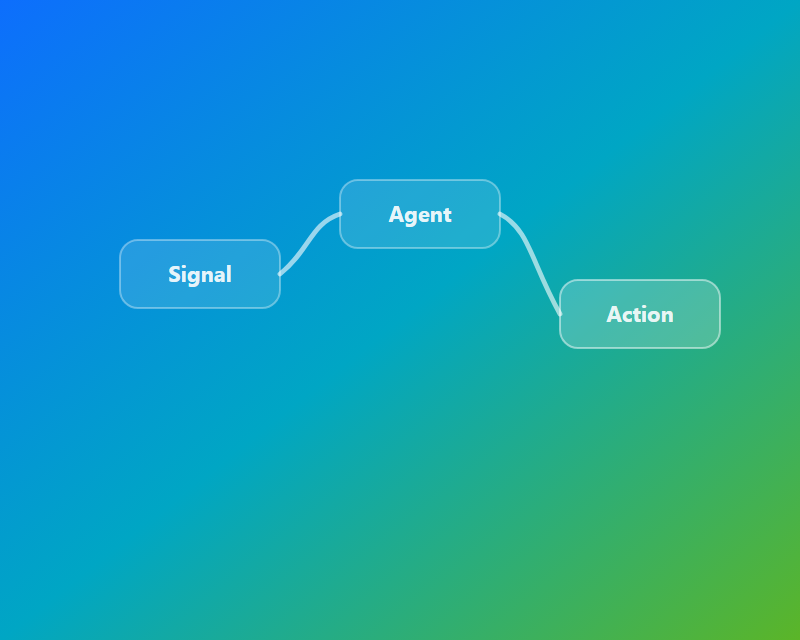
A point tool stops at one step. A connected revenue system carries a single signal through capture, routing, follow-up, and reporting — as one governed flow, with the evidence carried forward at every step.
That connected flow is the thing no collection of separate tools can structurally reproduce. You can integrate point tools with each other, but integration is not the same as one shared operating layer carrying context forward automatically. The connection is the product.
Does agent-driven AI mean losing control?
No. A well-designed agent layer is built to keep revenue leaders and sellers in control through clear trust tiers and explicit approval paths.
Routine, low-risk tasks — enrichment, routing nudges, hygiene checks, follow-up reminders — can run autonomously within defined limits. Anything that changes pipeline stage, account strategy, or buyer-facing messaging should be held for human approval. The AI drafts, suggests, and prepares; the team decides. Automation should never override operating judgment.
Why now?
The moment for agent-driven revenue operations has arrived because AI has crossed into mainstream GTM at the same time buyers expect faster, more relevant engagement.
Teams are already experimenting with research assistants, scoring models, and workflow automation — the technology is no longer theoretical. At the same time, consolidation toward fewer, better-coordinated systems is creating demand for one governable operating model that works the same way across marketing, sales, and CS. The conditions that make a connected, agent-driven platform valuable are all in place at once.
Here's the bottom line: the teams that win the next cycle won't be the ones with the most AI tools — they'll be the ones running on one intelligent, connected revenue system. That's the case for sequencing agent-driven workflows on top of sound operations, and it's the model Enableocity is built around.
One connected revenue system.
See what agent-driven workflows can do when the operating layer underneath is already sound.
Keep reading
More from the Enableocity blog
Why Your Forecast Is Wrong: The Five Deal-Inspection Signals Managers Miss
Most forecast misses trace back to the same handful of quiet warning signs. Here's what to check before the number ever hits the board deck.
The Lifecycle Stages Nobody Trusts (and How We Rebuilt Ours)
MQL and SQL definitions rot the moment sales stops believing them. A practical rebuild that got both teams back on the same page.
First-Call Scorecards: What We Measure Instead of "Did They Follow the Script"
Scripts don't survive contact with a real buyer. Here's the rubric we use to coach discovery calls without turning sellers into robots.
The Real Cost of Four Teams Using Four Different Definitions of "Pipeline"
Cross-functional GTM friction rarely shows up as one big failure. It shows up as a hundred small disagreements about what the numbers mean.
CRM Hygiene Isn't a Data Project. It's a Behavior Project.
You can't dedupe your way to a healthy CRM. The fix starts with what you ask sellers to type — and how much of that AI can infer instead.
Is Your Homepage Answer-Ready? A Checklist for AI Search Visibility
Buyers increasingly meet you inside an AI answer before they ever click through. Here's what makes a page legible to both humans and models.
Peer Stories Beat Case Studies — Here's the Library Structure We Use
A logo wall doesn't help a rep mid-call. A story mapped to persona, pain, and objection does. How we organize proof so sellers can actually find it.
Your Tool Stack Isn't Too Small. It's Uncoordinated.
Most GTM orgs don't need another platform. They need the six they already bought to agree on what a "qualified account" is.
We Gave SDRs an AI Research Assistant. Meetings Booked Went Up 3.1x.
The lift didn't come from sending more outreach. It came from spending the saved research time on better personalization per account.